
The Silent Killer: 3 Funnel Mistakes That Are Quietly Draining Your Revenue
You’re spending thousands of dollars on paid ads. Your team is grinding out content. Your traditional SEO and new AI search visibility (GEO) strategies are finally working, and traffic is ticking upward.
But when you open your dashboard, the revenue numbers aren’t budging. Your sales pipeline feels like a ghost town.
What gives?
The brutal truth is that most businesses don’t have a traffic problem—they have a plumbing problem. They are pouring expensive traffic into a leaky bucket. According to industry benchmarks, businesses with poorly optimized funnels lose up to 60% to 80% of potential deals purely due to broken friction points between a user’s first click and the final sale.
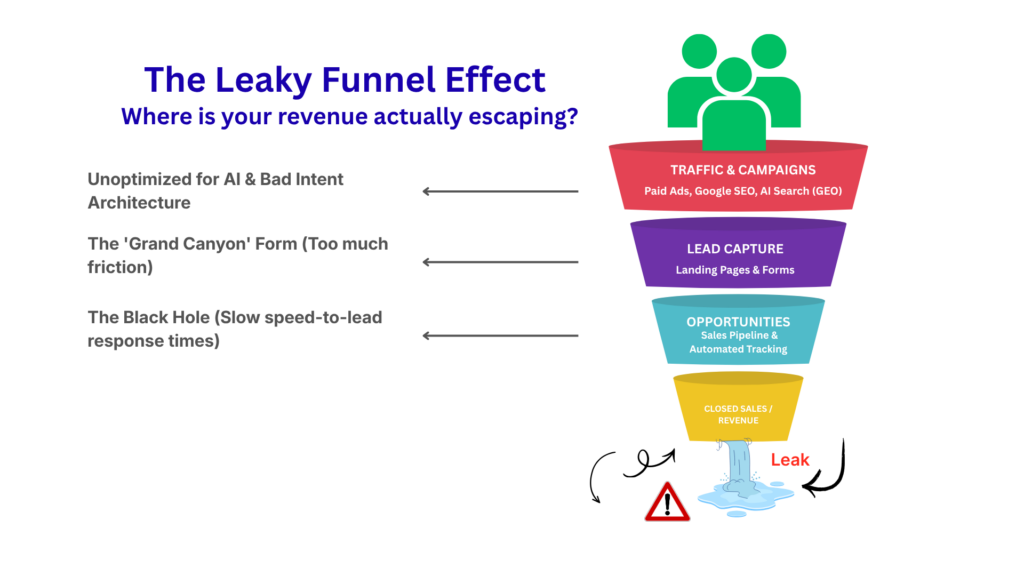
As shown above, when your funnel has structural leaks, you bleed prospects at every single transition phase—turning an expensive marketing campaign into a highly inefficient cash drain.
Here are the three critical funnel mistakes killing your leads right now, and exactly how to plug the holes.
1.The “Grand Canyon” Form (Too Much Friction, Too Soon)
We’ve all seen it: a user lands on a page looking for a simple resource or a quick quote, and they are greeted by a form that looks like a mortgage application. They are forced to hand over their company size, annual revenue, job title, and phone number before they even know if you can help them.
Every field you add to a lead capture form reduces conversions. If your entry-level offers require high-friction commitments, users will bounce straight back to Google—or worse, ask an AI engine for an alternative.
- The Fix: Use progressive profiling. Capture just an email and a first name upfront to get them into your CRM ecosystem. You can collect deeper operational data down the road once you’ve actually delivered some value.
2.The Black Hole of Lead Follow-Up (The “Speed-to-Lead” Crisis)
If a high-intent lead fills out a contact form on your website, how long does it take your team to respond? If it’s more than five minutes, you’ve likely already lost the deal.
Harvard Business Review data shows that companies attempting to contact potential leads within 5 minutes are nearly 100 times more likely to connect and qualify them than those waiting 30 minutes.
Yet, many businesses still have contact forms that just route to a generic info@company.com inbox that someone checks “once or twice a day.” By the time you reply, the prospect has moved on to a competitor who answered faster.
- The Fix: You need instant automation pipelines. The second a lead hits your site, an automated workflow inside a platform like HubSpot or GoHighLevel should instantly trigger an internal team notification, tag the source, and shoot a personalized email or SMS response to the prospect.
3.Treating All Traffic the Same (Ignoring Intent Architecture)
A common mistake is directing traffic from a high-intent search query (like someone looking for an immediate solution) and a low-intent social media click to the exact same landing page.
Worse, companies often fail to build pages that answer the specific structural formatting needs of modern search. If your landing pages don’t clearly state your pricing, core features, and data-backed outcomes in a clean format, human users and AI search crawlers will struggle to understand your value proposition.
Leaky vs. Optimized: Where Does Your Business Stand?
Funnel Element
The Leaky Funnel (Losing Money)
The Optimized Funnel (Scaling Revenue)
First Impression
Confusing layout; clear pricing hidden; slow load times.
Clear value prop; optimized for both human UX and AI search engines (GEO).
Lead Capture
8-field forms demanding deep data immediately.
2-field initial capture or low-friction digital growth audits.
Backend Tracking
Handled manually in spreadsheets; emails sent via Outlook.
Seamless CRM pipeline with automated 5-step lead nurturing workflows.
Speed to Lead
4 to 24 hours (whenever the team gets to it).
Under 5 minutes via automated internal and external notification triggers.
How to Stop the Bleeding
Fixing a broken funnel isn’t about throwing more money at paid ads or blindly writing more content. It’s about systematically finding where your data tracks break, where human users get confused, and where AI search engines lose track of your brand.
But when you are working in your business every day, finding your own blind spots is nearly impossible. You’re too close to the plumbing to see the leaks.
If you want to stop guessing why your traffic isn’t converting into revenue, let’s get an objective, expert pair of eyes on your entire ecosystem.
Get Your Custom 30–60 Day Growth Roadmap
Our Digital Growth Audit is a comprehensive, deep-dive evaluation designed to uncover exactly where your business is losing leads and how to fix it.
In just 7 to 10 business days, we will review your entire setup and hand you a prioritized execution plan.
- Website & Funnel Performance Audit: Pinpoint exactly where users are bouncing.
- SEO & GEO Baseline Review: See how your brand ranks on Google and how AI answer engines (like ChatGPT and Perplexity) perceive and cite your business.
- Paid Ads & Analytics Verification: Ensure your tracking is flawless and your ad spend isn’t being wasted.
- CRM & Automation Gap Analysis: Identify the exact workflows needed to slash your “speed-to-lead” times.
- 60-Minute Strategy Consultation: Walk through your custom roadmap step-by-step so your team knows exactly what to implement first.
The Investment: $1,500 USD / $2,050 CAD
Note: This is a fixed-scope, zero-obligation strategy project. You take the roadmap and implement it with your internal team, or have us handle the heavy lifting for you.
Don’t let another month of valuable leads slip through the cracks. Book your Digital Growth Audit today and let’s turn your leaky funnel into a high-converting revenue engine.
Revenue Funnel Optimization FAQs
Your revenue isn’t moving because your website is pouring expensive traffic into a leaky sales funnel with hidden friction points. When a funnel has structural flaws—such as overly long contact forms, slow team response times, or poor landing page layouts—businesses regularly lose 60% to 80% of potential deals before the final sale.
Long contact forms drastically lower conversion rates by introducing too much user friction too early in the customer journey. Forcing prospects to hand over deep data like revenue or company size before delivering value causes them to bounce; instead, you should use progressive profiling to capture just a name and email upfront.
Speed-to-lead is the exact amount of time it takes your business to respond to an inbound inquiry, and it directly dictates your closing rate. Data shows that responding to a lead within five minutes makes you nearly 100 times more likely to connect and qualify them than waiting 30 minutes, making instant CRM automation pipelines essential.
You optimize landing pages by matching the content directly to the user’s search intent and formatting data cleanly for both human visitors and AI search engines. High-converting pages avoid vague marketing jargon and instead present explicit pricing, clear features, and objective, data-backed case study results that engines like Perplexity or GPTBot can easily cite.